
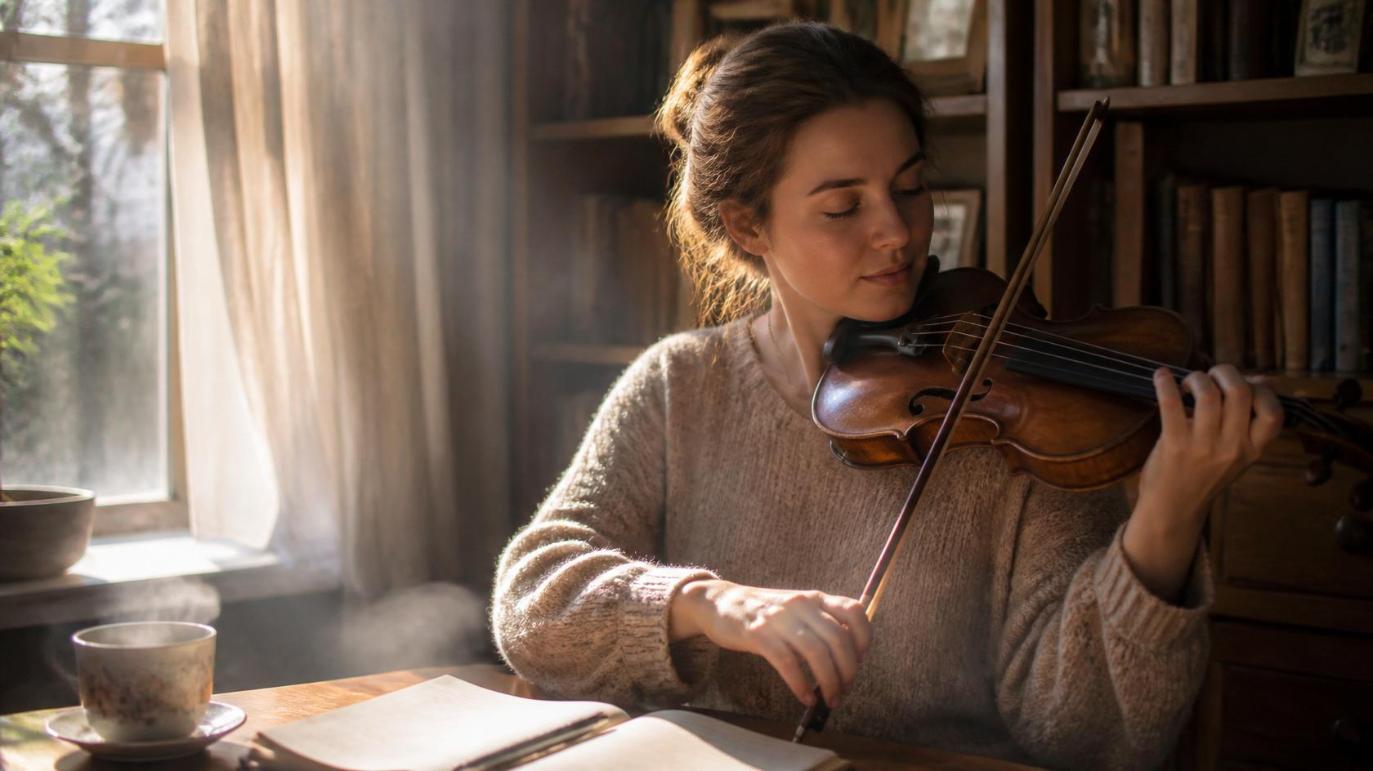
The silence before a bow strikes the strings is different. Writers know that silence well. It is the same one that fills the space before the first word of a new paragraph. Perhaps that is why a number of poets and writers have quietly taken up music, and the violin in particular, as a means of sharpening their craft.
Acquiring an instrument through violin rental has become a creative outlet for people who normally wrestle with the complexities of language on a page. The connection between writing and music grows more evident the longer you sit with both.
Musicians will tell you that an instrument does not only create sound but also changes the way you listen. When writers pick up a rented violin and bow, something shifts in how they hear language and description. Sentences begin to take on new dimensions.
What follows are five examples of how the bow and the pen tend to teach the same lessons.
Rhythm becomes a living thing
Poetry relies on rhythm, but that reliance should never allow one to forget that rhythm is, at its most basic, a physical sensation. Practicing with a bow and string gives a writer a felt sense of rhythm that reading alone simply cannot.
A writer starts to feel where a phrase wants to slow down or where it might want to jump. One novelist said her dialogue writing improved once she started playing. “I began hearing pauses,” she told me, “the way a bow rests between phrases.” That kind of felt knowledge has a way of sneaking into your writing in ways that grammar books and outlines never could.
Discomfort becomes a familiar teacher
Every beginner knows the sound of music gone wrong, and the soreness that comes with pressing unfamiliar strings night after night. Writers deal with something similar, that dysfunctional draft that sounds wrong in every direction, and learning to tolerate it long enough to find what it is trying to become.
Oddly enough, both experiences ask for the same thing: the stubbornness to keep going and the silence to let the work breathe. Crafting something new from the wreckage of a draft, whether it is a paragraph or a passage of music, requires the same patience.
Silence gains new weight
Musicians and writers think about pauses in surprisingly similar ways. Both understand that timing is everything. Meeting a blank page after a long sentence gives the punctuation room to settle. Playing the violin, even briefly, teaches you to value a pause as a choice rather than an absence.
That understanding carries over into prose and poetry, giving writers more confidence to let lines breathe instead of rushing to fill every space. The best writing often lives in what surrounds a line, not in the line itself.
Improvisation loosens the grip of perfectionism
Reading about the pros and cons of sheet music is one thing. Playing a note that is a little off and still continuing is another thing entirely. It is similar to a writer who wanders off the outline and discovers something better waiting there.
Both require a genuine trust of instincts. Writers who spend time with an instrument often become less precious about their drafts, more willing to treat their mistakes as turns in the road rather than evidence of failure.
The necessity of repetition
Nothing about daily music practice is particularly glamorous. Running scales is repetitive and, on some evenings, genuinely boring. But it builds something that typing does not: a kind of physical and mental endurance that carries you through the work even when the work sounds bad.
That discipline transfers. Writers who take on an instrument often find they develop a staying power at the desk that they did not have before. The repetition, whether with a bow or a keyboard, is what eventually produces growth.
The craft of observation
These five ideas are not connected by chance. They share a common root in the practice of paying close attention to small things. In both music and writing, a single breath or a single note that seems almost throwaway can turn out to be the most important one.
Writers who bring music into their lives are not always chasing technical skill. Many of them have no interest in performing in front of anyone. What they are after is what music, rhythm, and practice have to teach about imperfection and patience, which are the same things required to write a good page.
Between the reading and the playing, between the note and the word, there is a shared education that is worth seeking out, something that is really in between the lines of music and reading.
There is real value in stepping away from the keyboard now and then. Writing can keep you mentally captive, and a short session with an instrument will not free you entirely but it might loosen something. A new character sometimes shows up while you are tuning, and a freshly inspired line has a way of surfacing right after a warm-up scale.
You do not need to be a proficient musician to get something out of this. A willingness to be curious and uncomfortable is enough. There is a long history of artists pulling inspiration from other disciplines, and this will be no different. Pick it up and see what it has to offer.